
VISIT OUR LOCATIONS:
Arthritis describes more than 100 conditions affecting joints, surrounding tissues, or other connective structures. Osteoarthritis is the most common type. It develops as cartilage and other joint tissues gradually change, often affecting the hands, knees, hips, neck, and lower back. Inflammatory forms, including rheumatoid and psoriatic arthritis, involve immune-system activity and require medical management.
Symptoms may include aching, stiffness, swelling, tenderness, warmth, and restricted motion. As movement becomes difficult, you may change how you walk, grip, bend, lift, or exercise. Those compensations sometimes place additional stress on nearby muscles and joints.
Our arthritis chiropractor in Sarasota does not diagnose every joint complaint as arthritis or claim to reverse damaged cartilage. The purpose of a chiropractic examination is to identify restricted motion, altered mechanics, postural strain, and related spinal or extremity findings that may be adding to the problem.
Understanding the type of arthritis, the joints involved, and the source of current symptoms provides a safer basis for discussing care.
STIFFNESS MAY CHANGE WITH ACTIVITY, POSITION, AND TIME OF DAY
Arthritis symptoms vary with the type of condition and the joint involved. Osteoarthritis often develops gradually, while inflammatory arthritis may produce more widespread or persistent symptoms.
Symptoms may affect stairs, household tasks, sleep, golf, pickleball, swimming, and other parts of an active Sarasota routine. Joint pain may also come from a sprain, tendon problem, bursitis, nerve irritation, or another condition, so symptoms alone cannot identify the cause.
AGE IS ONE FACTOR, BUT IT IS NOT THE COMPLETE EXPLANATION
Different forms of arthritis have different causes. Mechanical stress may influence one person’s symptoms, while inflammation, previous trauma, or an autoimmune disease may be more important for someone else.
Body weight, genetics, muscle weakness, joint shape, prior injury, and certain occupations may also influence osteoarthritis risk. A careful examination matters because treatment for inflammatory disease, infection, fracture, or gout differs greatly from chiropractic care for mechanical restriction surrounding an arthritic joint.
Arthritis is a broad category rather than one diagnosis. These three conditions may create joint pain and stiffness, but their causes and medical needs differ.
Osteoarthritis develops as cartilage and other tissues within a joint change over time. It commonly affects the hands, knees, hips, neck, and lower back, producing pain, stiffness, swelling, and reduced motion.
Rheumatoid arthritis is an autoimmune disease that commonly causes painful, swollen, and stiff joints on both sides of the body. Early medical diagnosis matters because medication may slow joint damage and reduce complications.
Psoriatic arthritis is an inflammatory condition associated with psoriasis. It may affect the spine or extremity joints and may cause swelling, stiffness, tendon discomfort, or entire fingers and toes becoming swollen.

Chiropractic care does not cure arthritis, regrow cartilage, or replace medical management for rheumatoid, psoriatic, infectious, or crystal-related arthritis. It may have a supporting role when restricted joint motion, altered mechanics, muscle guarding, or compensatory movement contributes to discomfort.
For example, limited hip motion may change the way a person loads the knee or lower back. Stiffness in the mid-back may affect neck and shoulder movement. Pain in one knee may also create an uneven gait that increases stress elsewhere.
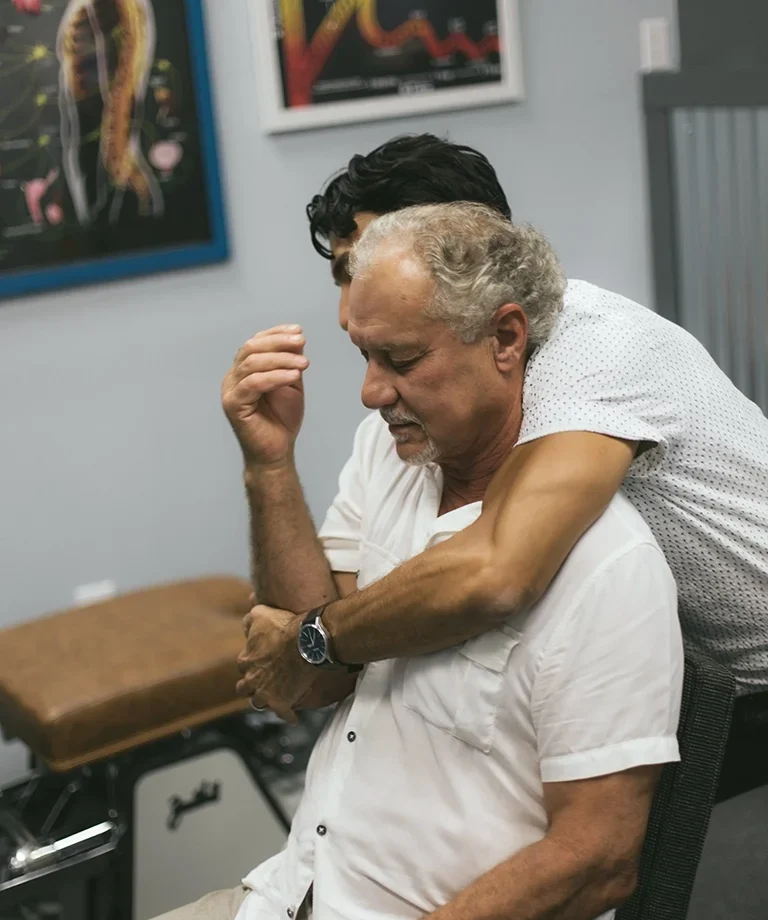
When examination findings with our chiropractors in Sarasota at Vertical Chiropractic® support care, a chiropractor may use specific spinal or extremity adjustments selected for the joints involved. The amount and direction of force should reflect the person’s age, bone health, condition, and tolerance. Movement guidance may also be discussed.
The evaluation begins with your diagnosis, symptom pattern, medical history, medications, previous injuries, surgeries, and activities that have become difficult. Our doctors also need to know if symptoms appeared gradually or suddenly and if you have experienced swelling, prolonged morning stiffness, fever, fatigue, or skin changes.
The physical examination may include posture, gait, range of motion, joint movement, muscle function, neurological findings, and selected orthopedic checks. When symptoms affect an extremity, we may examine the spine and connected joints because restricted motion in one region sometimes changes how another area carries load.
Imaging may be reviewed or discussed when clinically indicated. Chiropractic care is not appropriate for every arthritic joint or every condition. Hot, red, markedly swollen joints, fever, unexplained illness, recent trauma, suspected fracture, severe instability, rapidly worsening weakness, or new loss of sensation call for medical evaluation. Active inflammatory disease may also require coordination with a primary care physician or rheumatologist before manual care is considered.

Your first visit looks beyond an arthritis diagnosis to determine what may be limiting your movement. We review your symptoms, medical history, medications, previous imaging, surgeries, and related conditions. The new patient examination may include posture, gait, strength, sensation, spinal motion, extremity mechanics, and orthopedic checks. Our Sarasota arthritis chiropractors then explain the findings and discuss how chiropractic care may fit in. We may start with imaging, medical testing, or a referral when inflammation, fracture, infection, or instability is suspected.

The Gonstead Method gives our chiropractors a structured way to examine spinal movement and select a specific contact when an adjustment is appropriate. Depending on the area and clinical findings, this process may include visualization, static palpation, motion palpation, instrumentation, and review of relevant imaging.
Arthritis requires additional judgment because a joint’s structure, stability, inflammation, and available motion may differ considerably from those of a healthy joint. Vertical Chiropractic® also evaluates extremities when hip, knee, shoulder, wrist, ankle, or foot mechanics relate to the complaint. The purpose is not to apply force broadly. It is to determine which joints may be safely approached, which areas require modification, and when another form of care should come first.
Arthritis care requires more than locating the painful spot. Our doctors consider the diagnosed condition, involved joints, movement patterns, bone health, and connected spinal or extremity mechanics before discussing care.
Chiropractic care may support movement when restricted joint motion, altered mechanics, posture, or compensation contributes to discomfort. It does not cure arthritis or reverse structural joint damage. Its role depends on the type of arthritis, the joint involved, disease activity, bone health, and examination findings. People with inflammatory arthritis should continue medical care because medication may be necessary to control the underlying disease and protect the joints.
Care may be appropriate for some people with osteoarthritis after the joint and surrounding regions have been examined. The technique and force should reflect the degree of degeneration, available motion, stability, age, and any history of osteoporosis or surgery. A severely unstable, fractured, acutely swollen, or medically complicated joint may not be suitable for adjustment. An evaluation determines if care should be modified, deferred, or directed toward another area.
Osteoarthritis involves changes in cartilage, bone, and other joint tissues that typically develop over time. Rheumatoid arthritis is an autoimmune disease in which the immune system attacks joint tissues, causing inflammation and potentially affecting other organs. Osteoarthritis frequently affects particular weight-bearing or heavily used joints. Rheumatoid arthritis often creates symmetrical swelling and prolonged stiffness. Because their causes and medical needs differ, identifying the correct type is essential.
A rheumatologist should take the lead when symptoms suggest inflammatory or autoimmune disease. Warning signs include persistent joint swelling, warmth, prolonged morning stiffness, fatigue, fever, psoriasis, or several joints becoming painful without a clear mechanical reason. A chiropractor may evaluate movement and mechanical factors, especially when discomfort changes with posture or activity. Some patients work with both providers, with each focusing on a different part of care.
X-rays may reveal joint-space narrowing, bone spurs, alignment changes, or other structural findings associated with osteoarthritis. However, imaging findings and symptoms do not always match. Early disease may not be obvious, and inflammatory arthritis may require blood tests, ultrasound, MRI, or evaluation by a medical specialist. Imaging is one part of the clinical picture. Your history, physical examination, symptom pattern, and previous diagnoses remain important.
Appropriate movement is generally important for maintaining joint function, flexibility, muscle strength, and endurance. The activity should match the affected joint and current symptom level. Walking, swimming, strength training, or controlled mobility work may be suitable for many people. Sudden swelling, sharp pain, instability, or a significant increase in symptoms is a reason to pause and seek guidance. Exercise choices may also need modification during an inflammatory flare.
Seek timely medical care for a joint that becomes suddenly intensely painful, particularly if you also have a fever or feel unwell. Significant trauma, visible deformity, inability to bear weight, sudden weakness, or loss of sensation also requires prompt evaluation. These symptoms may indicate infection, fracture, acute inflammation, nerve involvement, or another problem that should be assessed before chiropractic care.
Vertical Chiropractic® evaluates arthritis-related joint stiffness and mechanical concerns at its downtown Sarasota office. Our doctors assess spinal and extremity motion, posture, gait, and connected movement patterns while considering your diagnosis and medical history. The visit is designed to clarify where chiropractic care may have a supporting role and when imaging, medical management, or another provider should take priority.
Persistent joint pain, recurring stiffness, or reduced movement may change how you work, exercise, sleep, and manage daily routines. An arthritis diagnosis matters, but it may not explain every mechanical restriction or compensation affecting your body.
Vertical Chiropractic® combines Gonstead analysis with spinal and extremity evaluation at its downtown Sarasota location. Our doctors use your history, examination findings, joint condition, and current medical care to determine the appropriate next step without promising to reverse the underlying disease.
Call Vertical Chiropractic® in Sarasota at 941-413-5099 or schedule your visit online to have your arthritis and joint pain properly evaluated.