
VISIT OUR LOCATIONS:

Each foot contains numerous bones, joints, ligaments, tendons, muscles, and nerves that work together whenever you stand or take a step. The ankle transfers force between the leg and foot while adapting to changes in direction, speed, and surface.
Pain may develop around the heel, arch, forefoot, toes, or either side of the ankle. Some people notice a sharp sensation during push-off, while others experience stiffness, swelling, burning, or an ache that grows after extended activity. These symptoms may interfere with walking downtown, playing pickleball, running, golfing, exercising, or remaining on your feet at work.
Possible sources range from a recent sprain to restricted joint motion, tendon irritation, nerve involvement, or changes in the way weight moves across the foot. Problems within the knee, hip, or lower back may also influence lower-extremity mechanics.
A focused chiropractic evaluation from our ankle and foot chiropractors in Sarasota studies where symptoms occur, how your foot and ankle move, and what happens during weight-bearing activity.
YOUR SYMPTOMS MAY CHANGE WITH EVERY STEP
Discomfort may begin suddenly after a misstep or build gradually without one memorable injury. The exact location, timing, and type of sensation offer useful information during an examination.
Symptoms may increase in unsupportive shoes, after prolonged standing, or during running and court sports. Some people also change their stride to avoid discomfort, placing new demands on the opposite foot, knee, hip, or lower back.
THE PAINFUL AREA IS ONE PART OF THE PICTURE
The foot and ankle absorb weight while adapting to the ground beneath you. Pain may appear when an injury, repeated stress, restricted joint, or change in walking mechanics alters that process.
Arthritis, gout, nerve irritation, fractures, and inflammatory conditions may produce similar complaints. An examination matters because soreness after activity requires a different approach to care than instability, nerve symptoms, or pain following significant trauma.
Ankle and foot pain may involve joints, tendons, ligaments, nerves, or the structures supporting the arch. These related conditions often create overlapping symptoms, which makes a focused examination important.
Ankle sprains involve stretched or torn ligaments, often producing swelling, bruising, tenderness, instability, and difficulty placing weight on the foot.
Shin splints create pain along the inner edge of the shinbone, commonly after increases in running, jumping, or repetitive activity.
Achilles tendinopathy causes stiffness and pain above the heel, particularly during running, stair climbing, jumping, or forceful push-off movements.
Flat feet describe lowered arches that may alter weight distribution, ankle motion, balance, and stress placed across the lower extremities.
A bunion forms at the base of the big toe, creating a visible bump, joint stiffness, swelling, and footwear-related discomfort.
Heel spur syndrome involves pain beneath the heel, often occurring alongside plantar fascia irritation rather than from the bony growth alone.
Morton’s neuroma involves thickened tissue around a forefoot nerve, causing burning, tingling, numbness, or pebble-like discomfort between the toes.
Metatarsalgia causes pain and inflammation beneath the ball of the foot, especially during standing, running, jumping, or walking barefoot.
Turf toe is a sprain of the big-toe joint that typically follows forceful bending during sports, running, or sudden push-off.
Hammer toe creates an abnormal bend in a smaller toe, which may lead to stiffness, pressure points, corns, and shoe irritation.
Cuboid syndrome may create outer-foot pain after an ankle injury, repetitive loading, or altered movement within the lateral foot joints.

Our Sarasota chiropractors for ankle and foot pain at Vertical Chiropractic® examine how the joints move during standing, walking, and selected activities. The evaluation may also include the knee, hip, pelvis, or lower back when those regions influence your symptoms.
When restricted motion or altered mechanics contribute to the problem, an extremity adjustment may be appropriate. Spinal or pelvic adjustments may also be considered when related findings are present. More serious injuries and systemic conditions require another route.
Your evaluation with our Sarasota foot chiropractor starts with the location of your symptoms, how the problem began, and which activities make it better or worse. Our doctors may observe your walking pattern, balance, ankle mobility, foot motion, strength, tenderness, and ability to bear weight.
The knee, hip, pelvis, and lower back may also be examined when they influence your stride or produce referred symptoms. Neurological checks become especially relevant when burning, numbness, tingling, or weakness is present.
Imaging or an outside evaluation may come first after significant trauma, visible deformity, severe swelling, suspected fracture, or an inability to bear weight. Redness, warmth, fever, an open wound, or rapidly progressing numbness also deserves prompt medical attention.
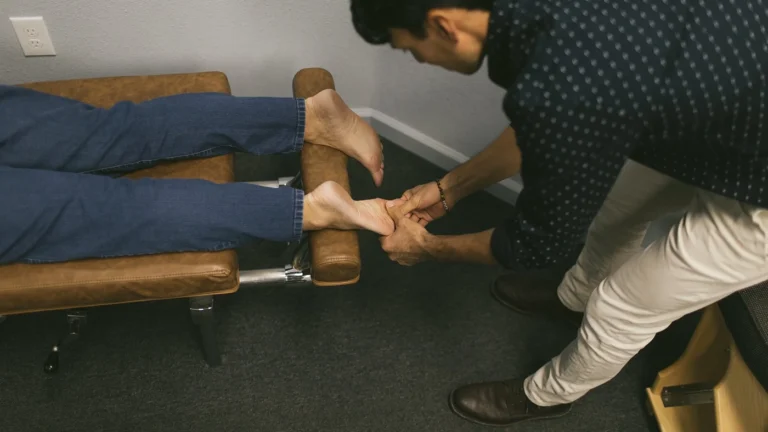
Your first appointment focuses on understanding why the ankle or foot hurts. We discuss when symptoms began, previous injuries, footwear, activities, and changes in walking or exercise.
The examination may include gait observation, joint mobility, balance, strength, neurological checks, and selected orthopedic tests. Related spinal and lower-extremity mechanics are studied when relevant. Existing imaging may be reviewed, while new imaging is discussed only when supported by the findings.
Afterward, our doctors explain what stood out and outline appropriate options. An adjustment is considered for a new patient only when the examination supports it. Another provider may be suggested when a different type of care should take priority.

Gonstead analysis allows our chiropractors to study spinal and pelvic findings that may influence lower-extremity movement. Depending on your symptoms, this process may involve visualization, static palpation, motion palpation, instrumentation, or a review of relevant imaging.
Extremity analysis shifts attention directly to the ankle and foot. Our doctors use an approach that examine the motion and position of individual joints while considering their relationship with the knee, hip, and walking pattern. When an adjustment is appropriate, the contact and direction reflect the restricted joint identified during the examination. Each person receives the components relevant to their presentation rather than an identical routine.
Ankle and foot complaints require an understanding of small joints, weight-bearing mechanics, and connected movement. Our doctors combine spinal analysis with advanced extremity training to develop care around your findings and activities.
Chiropractic care may be appropriate when restricted joint movement, altered mechanics, or compensation contributes to symptoms. An extremity evaluation studies the ankle and foot directly, while a spinal assessment looks for related findings elsewhere. Sprains with major ligament damage, fractures, infections, advanced arthritis, and systemic medical conditions may require care from another provider. The examination establishes which direction makes sense.
Heel pain during the first steps of the morning is commonly associated with plantar fascia irritation. Symptoms may ease as the foot warms up and return after prolonged standing or activity. Achilles tendon problems, heel-pad irritation, nerve involvement, and stress injuries may create pain in a similar area. The location of tenderness and response to movement provide useful distinctions during an examination.
A previous sprain may leave lingering stiffness, reduced balance, weakness, or a sense that the ankle gives way. Those changes may alter stride length and the way weight moves through the foot. Some people begin loading the opposite leg differently without realizing it. An examination compares both sides and looks at mobility, stability, strength, and connected lower-extremity mechanics.
Nerve irritation in the lower back may produce pain, burning, tingling, numbness, or weakness that travels into the ankle or foot. Symptoms that extend through the leg or change with spinal position deserve a neurological and spinal assessment. Local foot problems may create similar sensations, so the location alone does not confirm the source. The examination compares local findings with neurological signs.
Activity choices depend on the suspected structure, severity, swelling, stability, and ability to bear weight. Mild soreness may permit modified activity, while sharp pain, limping, worsening swelling, or instability suggests that continued loading is unwise. Avoid pushing through symptoms after a significant injury. Your examination findings provide a clearer basis for changing distance, intensity, footwear, or exercise selection.
Imaging may be appropriate after trauma, when bearing weight is difficult, or when the examination raises concern about a fracture, stress injury, arthritis, or another structural problem. X-rays show bone and joint alignment, while other forms of imaging may be discussed for certain soft-tissue concerns. Previous images are reviewed when relevant. New imaging is based on clinical need rather than ordered routinely.
Seek prompt medical evaluation for severe pain or swelling after an injury, visible deformity, an open wound, or an inability to place weight on the foot. Redness, warmth, tenderness, and fever may signal infection. Rapidly progressing weakness, widespread numbness, or unexplained swelling also deserves timely attention. These findings fall outside routine adjustment-based care until urgent causes have been ruled out.
Vertical Chiropractic® provides spinal and extremity evaluations at its downtown Sarasota office. Our doctors see active adults, athletes, older adults, and others whose symptoms affect walking, work, exercise, or recreation. Your appointment includes a focused history and physical examination before care options are discussed. The location offers access to individualized chiropractic care without placing every ankle or foot complaint into the same category.
Persistent ankle or foot pain may change how you walk, exercise, work, and complete ordinary errands. Vertical Chiropractic® evaluates local joint motion along with the lower-extremity and spinal mechanics connected to each step. Your care plan reflects the examination findings and the activities you want to resume.
Call Vertical Chiropractic® in Sarasota at 941-413-5099 or schedule your visit online to have your ankle and foot pain properly evaluated.